

CHAPTER I: THE THEORY OF DIGITAL VACUUMS & PHOTON ISOLATION
1.1 The Baseline Philosophy of the Void
Traditional fine-art photography is inherently compromised by the physical environment. When a photographer drops a subject into a physical studio space, ambient light reflects off the floorboards, color bounces from backdrops onto bare skin, and atmospheric dust catches stray illumination. This creates global contamination. The machine rendering engines, specifically Midjourney V8.2, replicate these physical compromises by default. They attempt to simulate realistic bounce light, causing color tokens to spill across boundaries.
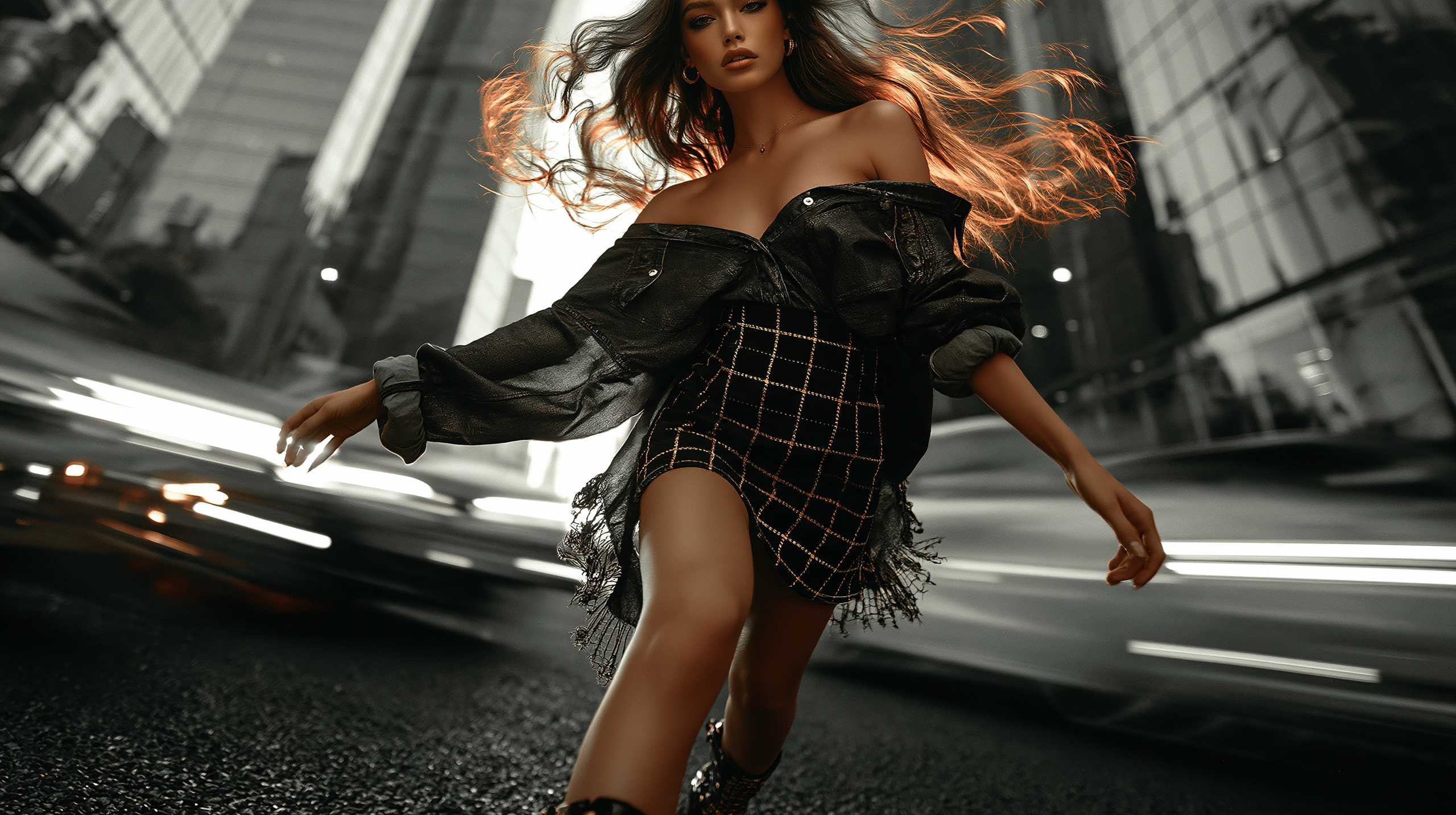
COPPERVOID™ begins with the complete rejection of environmental light behavior. It operates on the theory of the absolute digital vacuum—a simulated space where text tokens create a clean drop shadow barrier that completely isolates the subject. The background is not a dark room or a charcoal curtain; it is an absolute black digital void. It completely swallows shadows, forcing the subject to appear as though they are floating seamlessly in empty space.
1.2 The Hyper-Chroma Separation Field
To achieve true hyper-separated portraiture, the color space must be tightly restricted and placed under intense tension. The human eye consumes an image by evaluating the relationship between texture and spark. If the entire scene is saturated with color temperature, the brain interprets it as a standard snapshot.
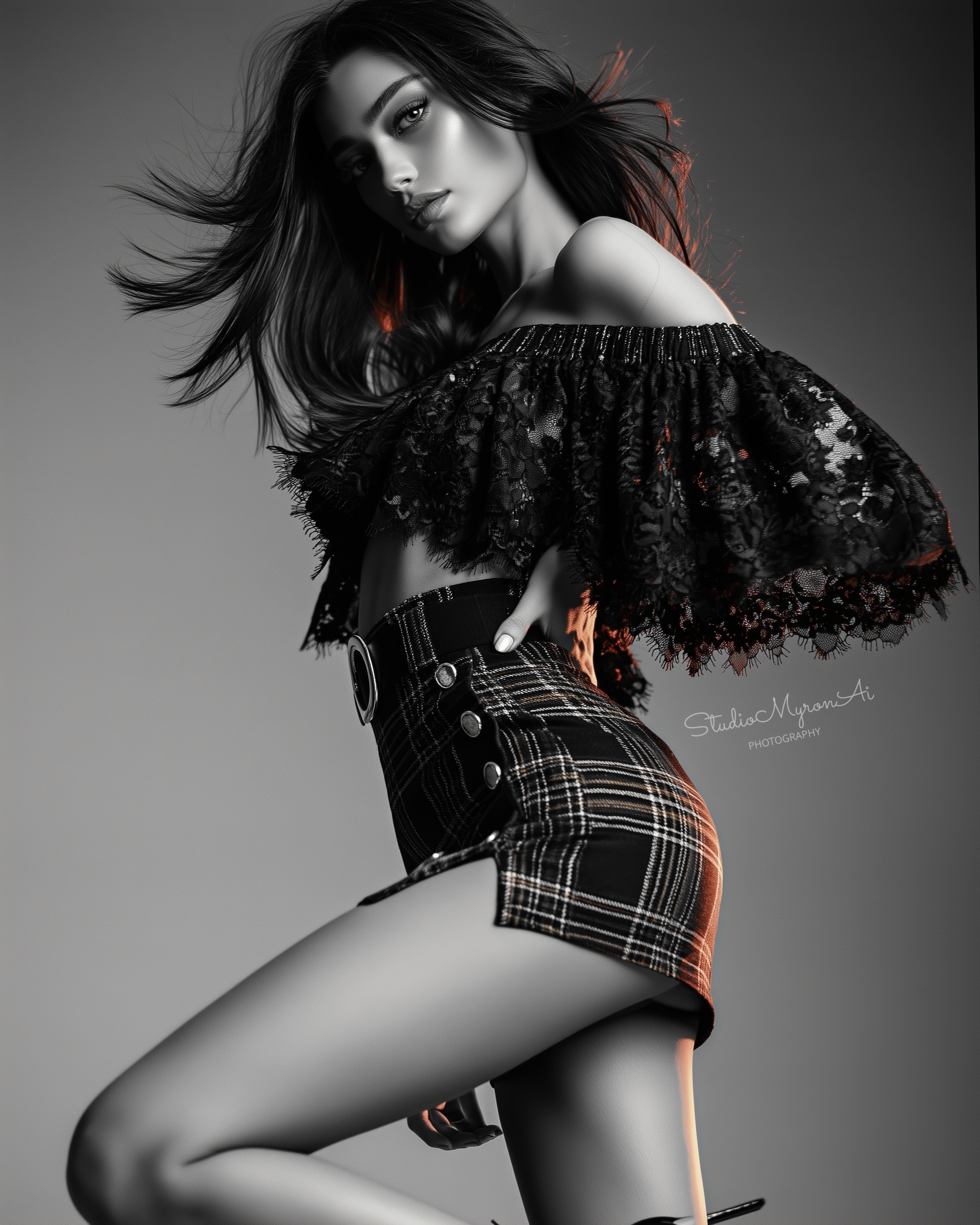
By flattening the primary form (skin, clothing, and environment structures) into high-contrast platinum grayscale values, we strip away all color-temperature distractions. This turns the subject into a sculpture of pure values spanning from #222 to #FFF. When an explosive color token like Ignited Copper (#E0611D) is introduced into this clean grayscale field, it does not act as an ambient light source. It treats the target pixels (active hair strands) like live electrical filaments, burning purely within the boundaries of active kinetic texture.
CHAPTER II: REVERSE-ENGINEERING MIDJOURNEY V8.2 LAYOUT GRAVITY
THE GRAVITY COLLAPSE PARADIGM (V8.2 DEFAULT):
[Prompt Tokens Input] ──► [Global Proximity Blend] ──► [Color Spill / Position Deficit]
THE ARCHITECTURAL ANCHOR MATRIX (COPPERVOID™ SYSTEM):
[Surface Base Anchor] ──► [Subject Posture Logic] ──► [Ceiling Canopy Vault] ──► [Isolated Separation]
2.1 The Proximity Collapse Error
The V8.2 neural network relies heavily on proximity flat-text reading. Because native mathematical string weights (:) have been suppressed in recent updates, the engine reads prompts as continuous, bleeding sentences. If you type:

A fashion portrait of a girl with orange hair standing next to a pond.
The machine collapses the proximity space. It reads the tokens for “standing” and “pond” together, dragging her boots directly into the current, completely failing to maintain the boundary between solid ground and reflection. This is known as a Spatial Gravity Hole.
2.2 The Geometric Protection Solution
To defeat the engine’s default alignment, you must build explicit physical boundaries directly into the prompt structure. You cannot simply tell the machine where she is standing; you must define the exact physical material separate from the environment.
- System Implementation: “She is walking entirely on a dry grassy bank completely separate from the water.” [1]
- The Result: The text creates a spatial barrier that blocks the pixel generator from leaking her boots into the water matrix.
CHAPTER III: THE COMPOSITION CODES — SURFACE & CEILING ANCHORS
3.1 The High-Angle Baseline Code (Look-Down Perspectives)
To achieve an uncompromised look-down shot that maintains deep vertical perspective without flattening the model, the ground under her feet must be treated as a high-texture geometric stage. If the base is flat or untextured, the engine compresses the camera height, resulting in a standard eye-level portrait.
AXIS Alt-Z Grid Mapping:
[Virtual Camera Plane] ──► Looking Down at 85 Degrees
├── Ground Anchor Target: Weathered Oak Planks / Cracked Concrete [3, 7]
└── Perspective Result: Model pushed off-center / Deep vertical recede [3, 7]
By anchoring her boots to a foundation etched with fissures, deep organic grain, or heavily weathered wood planks, you force the lens grid to calculate an authentic camera altitude. The result allows for complex, asymmetrical poses—like dangling her legs freely over an elevated edge—while the floor line recedes flawlessly into the lower distance.
3.2 The Low-Angle Ceiling Vault Code (Look-Up Perspectives)
To drop the virtual lens directly to the floor planks and force an epic, sweeping look-up perspective, you must build an undeniable structural roof directly over her head.
Without an explicit ceiling token, a look-up prompt will cause the machine to crop the entire background grid out of the frame. The horizon lines vanish, the towering tree canopies disappear, and you are left with an empty field of gray pixels. By mapping an intricate, textured vintage ceiling panel or a massive atmospheric storm canopy directly overhead, the engine has no choice but to tilt its axis straight up to fit both the environment boundaries and her silhouette into a vertical 4:5 frame.

CHAPTER IV: THE THREE COERCIVE LAWS OF COPPERVOID™ DESIGN
Systematic RuleTechnical Execution PerimeterCore Visual PurposeLaw I: Zero Photon Bleed
The copper color is strictly localized inside the moving hair geometry. No orange photons can cast onto the white fabric or skin layers.Breaks physical light casting laws to produce hyper-real, isolated digital separation.Law II: High-Key Specularity
Grayscale tones must possess high specularity (metallic sheen, wet-look skin, reflective textures).Prevents flatness; ensures monochrome components carry enough punch to compete with the copper brightness.Law III: Motion Polarization
Locks static forms into deep grayscale values, while using the signature amber hue solely to trace elements in active movement.Uses static values for structural form, and kinetic color accents for targeted visual energy.
4.1 Deconstructing Law I: Zero Photon Bleed
In standard rendering physics, a high-intensity illumination source like a colored gel automatically spills illumination onto surrounding materials. If a model has neon orange hair, her neck, shoulder blades, and collar shirt will absorb that ambient warmth.
Law I violates this rule completely. The copper token must remain entirely self-contained inside the hair volume geometry. This impossible physics shift is what gives the style its signature lookbook presence.
4.2 Deconstructing Law II: High-Key Specularity
If you drop a flat matte gray texture into an absolute black void, it gets swallowed. To make the monochrome elements stand their ground against the brilliant ignition of the copper hair, the surfaces must reflect light intensely. Clothing selections must leverage metallic silk, wet leather, high-gloss latex, or structured crisp pleats. This high specularity ensures that the silver-gelatin tones pop with diamond-sharp highlights.
CHAPTER V: ANATOMY OF THE BLOUSE PROXIMITY SCANNERS
5.1 The Post-Generation Exposure Trap (Layer 3)
When you publish your work on platforms or your website, you must ensure that your assets pass the strict, automated Post-Generation Image Scan (Layer 3) safety blocks. These algorithmic filters do not look at your text prompt; they evaluate the exact pixel placement of the final render.
When Midjourney, Stable Diffusion, Nano Banan, Other Platforms attempts to calculate loose, unbuttoned, slouchy fabric that sits off-the-shoulder during an active motion pose, its structural physics engine often glitches. It struggles to determine where the white metallic shirt ends and the skin begins. This confusion frequently causes the AI to render anatomical clipping or excessive upper torso exposure, immediately triggering automated safety blocks on an otherwise flawless fine-art portrait.
FABRIC COLLAPSE PERIMETER TRAP:
[Slouchy Drape] + [Off-Shoulder Neckline] + [Low-Waisted Skirt] ──► AI Anatomy Glitch ──► Layer 3 Safety Block
5.2 TailORING Solutions For Clean Composition Passing
To retain your raw, high-fashion styling without triggering the automated scanner, you must provide the machine with precise geometric boundaries.
- The Neckline Fix: Shift from loose “off-shoulder slouchy” language to structured “boatneck” or “wrap-front tie-waist” tailoring descriptors. This forces the fabric to terminate cleanly and intentionally at the ribcage or collarbone, revealing her midsection elegantly while maintaining distinct clothing lines that pass the safety scanners perfectly.
⚡ THE VAULT IS OFFICIALLY OPEN.
The waiting is over. The complete, uncompromised COPPERVOID™ Brand Blueprint & Technical Identity Manual has been unlocked and deployed for public download.
If you are a commercial director, fine-art photographer, or digital artist looking to master Midjourney V8.2's spatial geometry, force extreme camera axes, and lock down zero-bleed hyper-chroma lighting, this is your syllabus.
Stop guessing prompts. Start commanding pixels.
🔗 Claim your uncompromised copy of the blueprint instantly right here: Download the COPPERVOID™ Manual
The Edwards Art Blog
Part I: The Genesis of Intent — Seeing Before Generating

THE UNTAMED HORIZON: WILLA IN THE TEXAS HILLS
Master Class: Fine Art Lighting and Textured Portraits — The Making of Mae

Blog Post: The Ultimate AI Art Prompt — Craft a Museum-Grade Masterpiece in One Click

The Controlled Chaos of Creation: On Prompting, Privacy, and the Pursuit of Precision

Shadows of Silk and Thorns: A Dark Fairy Queen’s Ethereal Realm

The Art of Ethereal Realism: A Black Porcelain Feminine Figure with Soul-Piercing Beauty

The Rubedo Cipher Rite

Coded Cipher XO

The Muse: Cipher Draft No. 1

Saharan Cipher X Princess — Limited Digital Art Collection | Museum-Grade Warrior Princess in Black & Gold Desert Fantasy

The 5 Principles of Using AI—And Why You Should Make Them Part of Your Daily Routine

Beyond the Mask: Deconstructing the Eve

Mystical Elvin Princess
